
Why Top Floors Overheat: Air Balancing Solutions for Multi Story Desert Homes
When we talk about air balancing solutions for multi-story desert homes, we have to address the elephant in the room—or rather, the heat in the attic. Physics is often the primary culprit behind your comfort issues. Through a process called thermal stratification, air organizes itself by temperature: the cool, dense air stays downstairs, while the warm, less-dense air rises to your bedrooms.
This is exacerbated by the “stack effect.” In a tall home, warm air escapes through small leaks in the upper ceiling or attic, creating a vacuum that pulls more air from the lower levels upward. If your home has a grand entryway or an open staircase, you essentially have a “heat highway” moving warmth directly to where you sleep.
Furthermore, solar heat gain is relentless in Arizona. Your roof acts like a giant radiator. During a typical July afternoon in Phoenix or Peoria, roof surface temperatures can soar to 150°F or higher. That heat conducts through the roofing material into the attic, where it radiates downward into your second-story ceiling. Even with the AC blasting, the ceiling itself can become a source of radiant heat, making the room feel like a furnace. Understanding how to fix hot and cold spots at home starts with realizing that your HVAC system isn’t just fighting the air temperature; it’s fighting the heat stored in your home’s structure.
The Impact of Hot Roofs and Attics on Air Balancing
The relationship between your roof and your comfort is direct. In desert climates like ours, radiant heat is the primary driver of top-floor overheating. When the attic reaches extreme temperatures, it doesn’t just heat the rooms below; it heats the ductwork running through that space. If your ducts aren’t properly insulated, the air your AC just spent energy cooling gets warmed up before it even reaches the vent.
Research shows that during grid-on heat waves, improving roof insulation can reduce “unmet degree-hours” (the time a room stays hotter than the thermostat setting) by 37% in single-family homes. Without this protection, top-floor units in multi-family or multi-story buildings often experience indoor temperatures that exceed the actual outdoor air temperature. This is why air balancing isn’t just about the machine; it’s about the envelope.
How Building Age Affects Air Balancing Solutions for Multi Story Desert Homes
The age of your home in Glendale or Scottsdale plays a massive role in how we approach air balancing. Data from studies in similar desert climates (like Fresno’s disadvantaged communities) shows that over 90% of homes built before 1980 struggle with uneven airflow.
Older homes often have:
- Leaky Envelopes: Decades of settling create gaps that let cool air escape and hot dust in.
- Insulation Degradation: Traditional fiberglass batts can settle or lose effectiveness over 40 years.
- Vintage HVAC Design: Many older homes were designed when energy was cheaper, using oversized units and undersized ductwork that can’t handle the static pressure required for modern air balancing.
If you live in a vintage desert residence, your air balancing solutions for multi-story desert homes might need to start with sealing the “thermal shell” before we even touch the thermostat.
Advanced Zoning and Smart Vent Technology
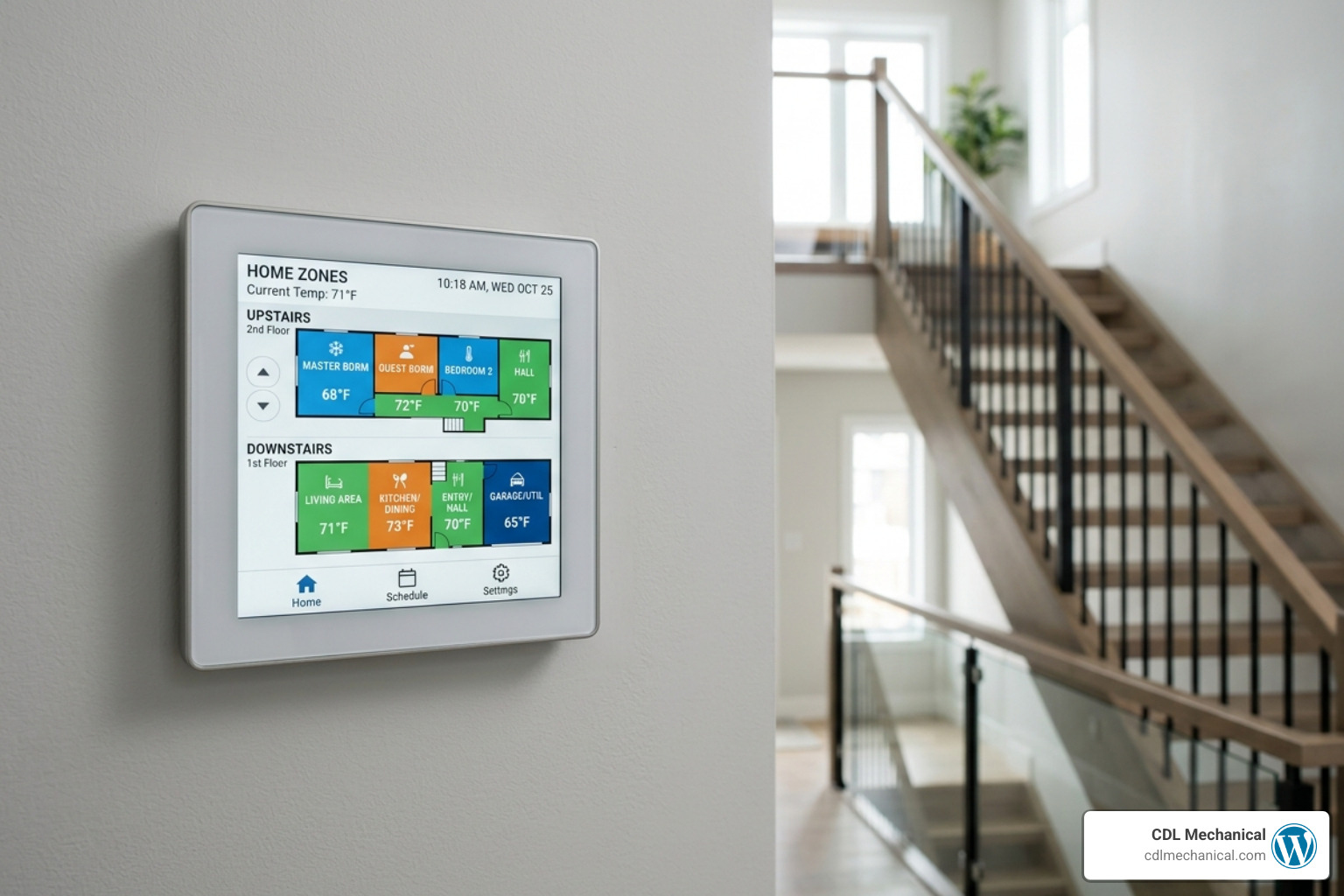
In the past, the only way to “balance” a home was to walk around and manually move the levers on your floor registers. Today, we have much more sophisticated tools. Air Balancing has evolved into a high-tech science.
One of the most effective ways to manage a multi-story home is through a zoned HVAC system. This involves installing motorized dampers inside your ducts. Each floor (or even each room) gets its own thermostat. When the upstairs gets too hot, the system closes dampers to the downstairs and funnels all the cooling power to the bedrooms. This is particularly effective when paired with variable-speed systems that can “ramp down” their output so they don’t over-pressurize the ducts when only one zone is calling for air.
| Feature | Manual Vent Adjustment | Smart Zoning Systems |
|---|---|---|
| Precision | Low (Trial and error) | High (Sensor-driven) |
| Automation | None (You are the robot) | Fully Automatic |
| Pressure Management | Risky (Can damage blower) | Safe (Monitors static pressure) |
| Efficiency | Marginal | Up to 30% energy savings |
| Comfort | Uneven | Consistent across all floors |
Implementing Smart Vents and Pucks for Automatic Airflow
For homes where retrofitting full-scale motorized dampers is too invasive or expensive, smart vents like Flair Pucks offer a brilliant alternative. These systems use wireless “Pucks” that act as room-specific thermostats and controllers.
These Pucks communicate with smart vents that replace your standard floor or ceiling registers. If the Puck in the master suite senses the temperature is 3 degrees higher than your target, it tells the smart vent to open wider while perhaps slightly closing a vent in a guest room that isn’t being used. This provides room-by-room control without tearing into your drywall.
When we install these in homes with pitched roofs and attics, we have to be mindful of signal strength and pressure differentials. Our team ensures that the system is configured so it never closes too many vents at once—a mistake that can cause your evaporator coil to freeze or your blower motor to burn out.
Custom Air Balancing Solutions for Multi Story Desert Homes in Glendale
Every home in the Phoenix Valley is unique. A “cookie-cutter” approach to airflow doesn’t work when one home has south-facing floor-to-ceiling windows and the neighbor has a shaded porch. At CDL Mechanical, we use professional-grade tools to perform a “TAB” (Testing, Adjusting, and Balancing) report.
We use anemometers to measure the velocity of air coming out of every vent and manometers to check the static pressure inside the system. We then apply two main techniques:
- Proportional Balancing: We find the “weakest” vent (usually the one furthest from the AC unit) and adjust all other vents to match its flow proportionally based on the room’s square footage.
- Predictive Balancing: We use data about your home’s layout and local Glendale climate trends to anticipate heat loads and set the system to stay ahead of the afternoon sun.
Passive Cooling and Heat Resilience Strategies
While we love high-tech HVAC, the best air balancing solutions for multi-story desert homes include passive measures. If we can stop the heat from entering the home, the HVAC system doesn’t have to work as hard to move it around.
Natural Ventilation and Grid-Off Resilience
In Arizona, we always have to think about “what if the power goes out?” During a summer heat wave, a power outage in a multi-story home can become dangerous quickly, especially on the top floor.
Natural ventilation strategies can reduce “unmet degree-hours” (UDH) by 21-26% in top-floor zones. This involves “night flushing”—opening windows in a specific pattern when the desert air finally drops below 85°F at night to let the heat escape, then sealing the home tight before the sun hits the horizon. This uses the stack effect to your advantage, pulling cool air in through lower windows and letting hot air exhaust through upper-story openings.
Solar Heat Gain Mitigation with Cool Roofs and Films
If your second floor has large windows, they are essentially heat lamps. Solar-control window films are a game-changer for air balancing. Research indicates these films can reduce UDH by 8-20% across both top and lower floors. By reflecting infrared light, the film keeps the “solar load” out of the room, meaning your AC doesn’t have to dump as much air into that specific space to keep it cool.
Similarly, “cool roofs”—roofs with high solar reflectance—and “cool walls” can significantly lower the temperature of the building’s skin. In multi-family district studies, roof insulation alone has been shown to reduce heat stress by 24-37% during extreme events. For a Glendale homeowner, this means the difference between an AC that runs 22 hours a day and one that cycles off periodically, saving you money and wear on the equipment.
Maintenance and Performance Optimization
You can have the most expensive zoning system in the world, but if your filters are clogged with Arizona dust, your air balancing will fail. Maintenance is the foundation of airflow.
- Timely Repairs: A small refrigerant leak or a failing capacitor can reduce the “sensible cooling” capacity of your system, making it impossible to reach the setpoint on the second floor.
- Filter Changes: In the desert, we recommend checking filters monthly. A dirty filter increases static pressure, which kills airflow to the furthest vents (usually the ones upstairs).
- Ductwork Sealing: The Department of Energy estimates that the average home loses 20-30% of its air through duct leaks. In a multi-story home, a leak in a vertical “chase” means the air intended for your bedroom is actually cooling the inside of your walls.
- Coil Cleaning: Our Glendale sun creates a lot of dust. If your outdoor condenser coil is caked in grime, it can’t shed heat effectively, leading to longer run times and higher bills.
Frequently Asked Questions about Desert Air Balancing
How do I manually adjust vents for better balance?
While we recommend professional service for a permanent fix, you can perform a “seasonal balance.” In the summer, try partially closing (never fully closing) the vents on the ground floor to force more air upstairs. Ensure that your return air grilles are never blocked by furniture, as the air needs a clear path back to the system to be re-cooled.
What are the benefits of a cool roof in Arizona?
A cool roof uses reflective materials to bounce sunlight away. This can reduce the surface temperature of your roof by up to 50°F. For multi-story homes, this drastically reduces the “radiant load” on the top floor, making it much easier for your HVAC system to maintain a balanced temperature between levels. It also helps mitigate the “urban heat island” effect in densely populated areas like Phoenix.
Why is my second floor always 10 degrees hotter?
It’s usually a “triple threat”: heat rising from downstairs (convection), heat radiating from the attic (radiation), and poor return air flow. Many older multi-story homes have plenty of supply vents upstairs but not enough return vents to pull the hot air out of the rooms. Without a way to “exhaust” the heat back to the AC unit, the cool air can’t get into the room—it’s like trying to pour water into a bottle that’s already full.
Conclusion
Living in a multi-story home in the desert shouldn’t mean choosing which floor you’re allowed to be comfortable on. By combining air balancing solutions for multi-story desert homes—like smart zoning, passive cooling, and professional TAB adjustments—you can reclaim every square inch of your residence, from the basement to the master suite.
At CDL Mechanical, we’ve spent years mastering the unique challenges of the Glendale and Phoenix climate. We’re a family-owned business, and we treat your home’s comfort as if it were our own. We understand that a cool home isn’t just a luxury here; it’s a necessity for your family’s health and happiness.
Whether you’re dealing with a “hot” second floor, skyrocketing energy bills, or a system that just won’t stay balanced, we’re here to help. Our expert technicians have the tools and the local experience to diagnose your airflow issues and implement a solution that lasts.
Don’t let the desert heat dictate how you use your home. Schedule your professional air balancing today and experience the difference that expert calibration can make. We serve Glendale and all surrounding areas, including Peoria, Sun City, and Scottsdale. Let us bring the balance back to your life.