
Why Air Balancing Benefits for Home Comfort Matter More Than You Think
Air balancing benefits for home comfort include consistent room-to-room temperatures, lower energy bills, better indoor air quality, and less wear on your HVAC system. Here’s a quick look at what proper airflow calibration actually does for your home:
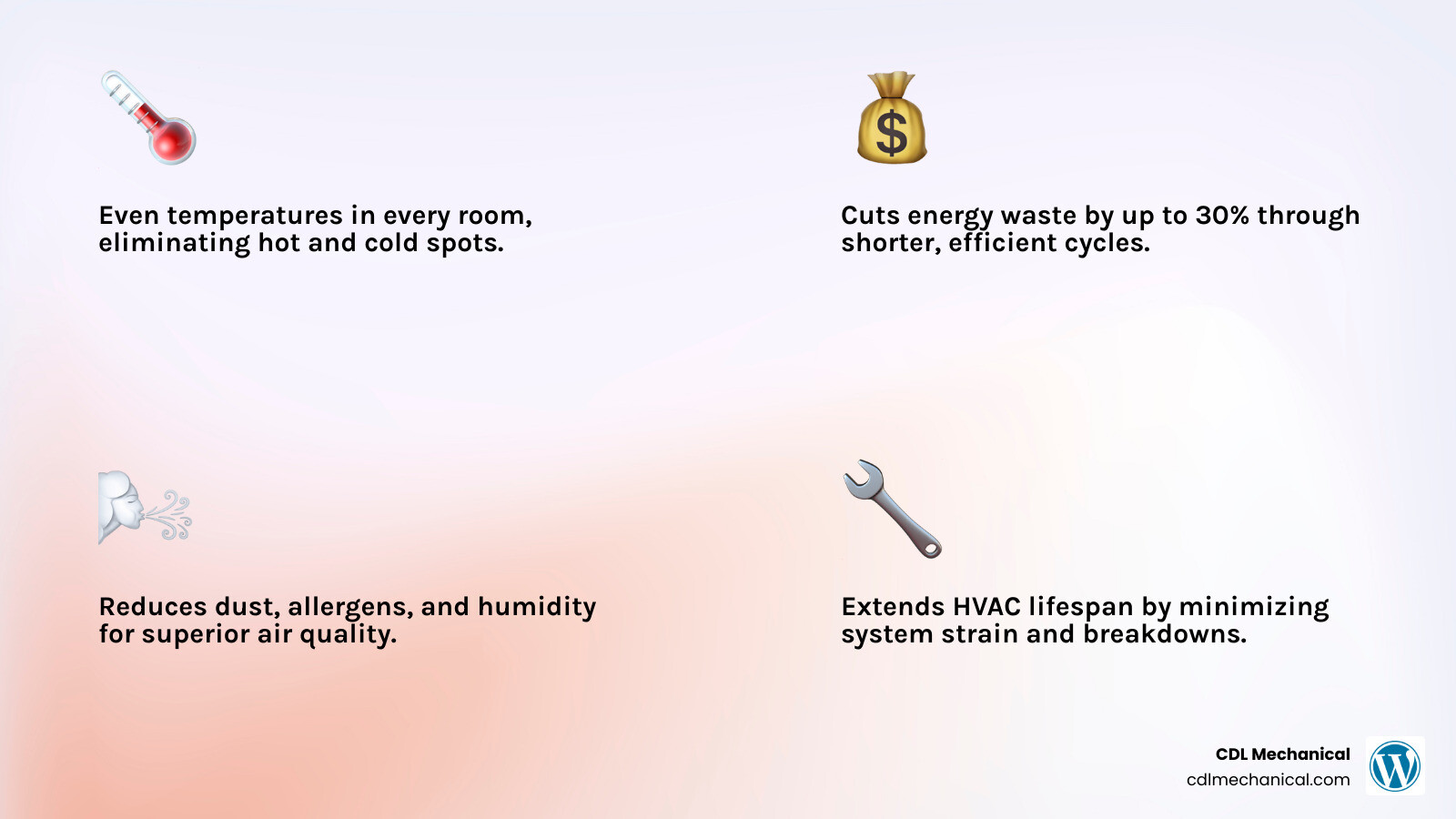
- Even temperatures — Every room reaches the same comfortable level, no hot or cold spots
- Lower energy bills — A balanced system runs shorter, smarter cycles, potentially cutting heat energy waste by up to 30%
- Better air quality — Balanced airflow reduces dust, allergens, and humidity buildup
- Longer HVAC lifespan — Less strain on your system means fewer breakdowns and a longer service life
- Quieter operation — Properly balanced systems don’t work as hard, so they run more quietly
If you live in Glendale, AZ, you already know the drill. One room feels like a walk-in freezer while another feels like you forgot to leave the oven on. You adjust the thermostat. Someone else adjusts it back. Nothing really gets fixed — because the real problem isn’t the thermostat setting. It’s the airflow.
Most homes lose comfort not because the HVAC unit is broken, but because the air moving through the system isn’t distributed evenly. Some rooms get too much. Others don’t get nearly enough. In the Phoenix desert heat, that’s not just uncomfortable — it’s expensive.
That’s exactly what air balancing is designed to fix. And it’s a lot more straightforward than most homeowners realize.
I’m Joshua Michael Bartlett, owner of CDL Mechanical, and with over 20 years of hands-on HVAC experience across Texas and Arizona, I’ve seen how addressing the air balancing benefits for home comfort can completely transform how a home feels and performs. In the sections ahead, I’ll walk you through everything you need to know — from the warning signs to what the fix actually looks like.
Understanding Air Balancing and Its Role in Your HVAC System
At its core, Air Balancing is the process of testing and adjusting your HVAC system to ensure that every room in your home receives the exact amount of conditioned air it needs. Think of your HVAC system like the circulatory system in your body; if the blood isn’t reaching your fingertips, they get cold. In your home, if the air isn’t reaching the guest bedroom or the home office, those rooms become uncomfortable “dead zones.”
To understand how this works, it helps to know How Does Central Heating And Cooling Work. Your system pulls air in, conditions it (heats or cools it), and then pushes it back out through a network of ducts. However, air is lazy—it takes the path of least resistance. This means rooms closest to the indoor unit often get blasted with air, while the master suite at the end of a long duct run barely gets a breeze.
When we perform air balancing, we are looking for specific CFM (Cubic Feet per Minute) targets. A general industry goal is often around 300 CFM per vent register, though this varies based on the size and “load” of the room. We also look at pressure equalization. If the air going out (supply) doesn’t match the air coming back (return), the system becomes “unbalanced,” creating “hot spots” or “cold spots” that drive homeowners crazy.
The Primary Air Balancing Benefits for Home Comfort
The most immediate of the air balancing benefits for home comfort is the end of the “thermostat wars.” We’ve all been there: one person is shivering in the living room while another is sweating in the kitchen. When a system is balanced, the temperature remains consistent throughout the entire house.

By ensuring every room reaches the same temperature simultaneously, you can finally learn How To Fix Hot And Cold Spots At Home for good. This isn’t just about luxury; it’s about efficiency. Statistics show that up to 30% of heat energy can be wasted in the winter (and a significant amount of cooling energy in our Arizona summers) due to unbalanced airflow. By correcting these issues, you aren’t just more comfortable—you’re stopping a massive leak in your monthly budget. Proper Air Conditioning Maintenance should always include a check of the system’s balance to ensure you aren’t paying for air that never reaches you.
Realizing Air Balancing Benefits for Home Comfort Through Better Air Quality
Most people think of air filters when they think of air quality, but airflow is just as important. When air is unbalanced, some rooms suffer from stagnant air. This lack of circulation allows dust, pet dander, and allergens to settle and accumulate.
Furthermore, in our humid monsoon seasons or even during standard operation, unbalanced airflow can lead to localized humidity spikes. If a room doesn’t get enough dry, conditioned air, moisture can linger, potentially leading to mold or mildew growth. By balancing the system, we ensure that air is constantly filtered and dehumidified in every corner of the home, which is a major win for anyone dealing with asthma, COPD, or general allergies.
How Air Balancing Benefits for Home Comfort Lead to Lower Energy Bills
In April 2026, energy standards are higher than ever, and efficiency is the name of the game. An unbalanced HVAC system is a stressed HVAC system. When your thermostat is located in a hallway that stays cool, but your bedrooms are sweltering, the system will shut off before the bedrooms are comfortable. Conversely, if the thermostat is in a hot spot, the unit will run non-stop, trying to cool a room that the ductwork simply can’t handle.
This “short-cycling” or over-running leads to massive utility bills. One of the 5 Benefits Of Routine Ac Maintenance is the reduction of this mechanical strain. When the air is balanced, the system reaches the set temperature across the whole house more quickly and stays there longer, meaning the compressor and blower motor don’t have to work nearly as hard. This leads to lower energy bills and a significantly longer lifespan for your expensive HVAC equipment.
Common Signs Your Glendale Home Needs Airflow Recalibration
How do you know if your home in Phoenix, Scottsdale, or Peoria is struggling with balance? Here are the “red flags” we tell our customers to watch for:
- The 2-Degree Rule: If there is more than a 2 to 3-degree difference between rooms, your system is likely out of balance.
- Weak Airflow: You put your hand up to a vent and feel a faint whisper of air while other vents are blasting like a gale-force wind.
- Whistling or Rattling: Excessive noise often indicates that too much air is being forced through a duct that is too small, or that ductwork has become restricted or disconnected.
- Thermostat Battles: If you find yourself constantly adjusting the temperature because you can’t get comfortable, the setting isn’t the problem—the distribution is.
- High Bills: If your energy costs are rising but your usage habits haven’t changed, your system is likely working overtime to compensate for poor airflow.
How Professionals Perform Air Balancing Services
While there are small things you can do yourself, true air balancing is a data-driven science. When our technicians arrive at a home in Surprise or Sun City, we don’t just “feel” the air; we measure it.
The process typically involves several high-tech tools:
- Flow Hoods: This device fits over a vent to measure exactly how much air (CFM) is coming out.
- Anemometers and Manometers: These tools measure air velocity and static pressure within the ducts. This tells us if the “blood pressure” of your HVAC system is too high or too low.
- Hygrometers: We check humidity levels and heat gains/losses in different rooms.
- Damper Adjustments: Most duct systems have internal “dampers”—metal valves inside the pipes. We adjust these to “choke” the air going to rooms that get too much and “open” the flow to rooms that are starving for air.
- Blower Fan Calibration: Sometimes the fan speed itself needs to be adjusted to match the total needs of the home.
- Duct Sealing: We often find leaks or disconnections in the attic that are “bleeding” conditioned air into the crawlspace instead of your living room.
DIY Limitations and When to Call the Experts
We often see homeowners try to “DIY” their air balance by completely closing vents in unused rooms. Warning: Do not do this. Closing more than one or two vents increases “static pressure” in your system. It’s like trying to breathe through a straw while someone pinches it shut. It can actually cause your evaporator coil to freeze up or cause your blower motor to burn out prematurely.
You can certainly make minor adjustments by partially closing the louvers on your registers or ensuring furniture isn’t blocking the vents. However, these are “band-aid” fixes. If your home has a complex layout, two stories, or a large addition, you need professional diagnostics.
At CDL Mechanical, we treat your home like our own. We use specialized software to analyze the data we collect from your vents and provide a report that shows exactly where the air is going. This ensures the fix is permanent and precise. Regular Air Conditioning Maintenance is the best way to catch these issues before they lead to a mid-July breakdown.
Frequently Asked Questions about Air Balancing
When is the ideal time to schedule professional air balancing?
The best time is right now, or specifically at the start of a major cooling or heating season. If you’ve recently completed a home renovation, added a new room, replaced your windows, or installed a new HVAC system, air balancing is essential to ensure the new setup works with your home’s existing footprint.
Can air balancing extend the lifespan of my HVAC unit?
Absolutely. Most HVAC failures are caused by stress. When a system is unbalanced, it runs longer cycles and operates under higher pressure than it was designed for. By balancing the airflow, you reduce the workload on the compressor and blower motor, which are the two most expensive parts to replace.
Why shouldn’t I just close the vents in unused rooms?
As mentioned earlier, your HVAC system was designed to move a specific volume of air. When you close vents, that air has nowhere to go, which increases pressure inside the ducts. This can lead to duct leaks, whistling noises, and significant mechanical damage to your AC unit. It is always better to have a professional adjust the internal dampers rather than closing the registers at the ceiling.
Conclusion
Achieving total Glendale comfort shouldn’t feel like a game of chance. You shouldn’t have to choose which room is going to be “the comfortable one” today. With expert calibration and a focus on the air balancing benefits for home comfort, you can enjoy a home that is consistently cool, remarkably quiet, and much cheaper to operate.
As a family-owned service, we at CDL Mechanical take pride in helping our neighbors from Buckeye to Cave Creek find the perfect balance in their homes. If you’re tired of hot spots and high bills, it’s time to look beyond the thermostat and look into your airflow.
Ready to experience a perfectly balanced home? Air Balancing is the key to lasting desert comfort. Give us a call today, and let’s get your home back in sync.