
Why How Air Balancing Improves HVAC Efficiency Is the Key to a Comfortable Glendale Home
How air balancing improves HVAC efficiency comes down to one simple idea: when conditioned air reaches every room in the right amount, your system stops working overtime to fix the difference.
Here is a quick breakdown of how it works:
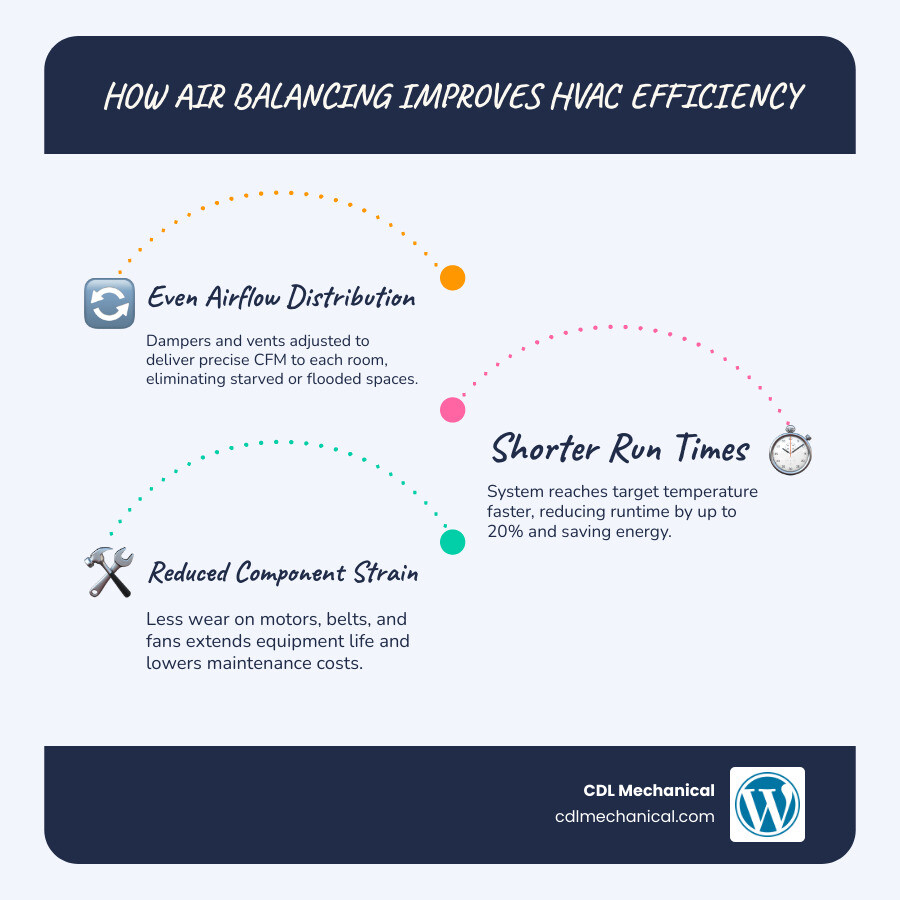
- Even airflow distribution – Adjusted dampers and vents deliver the right volume of air to each room, so no space is starved or flooded
- Shorter run times – When your system is not fighting uneven distribution, it reaches the target temperature faster and shuts off sooner
- Less strain on components – Motors, belts, and fans wear out faster when the system runs longer than it should
- Lower energy bills – HVAC systems operating outside their designed airflow range can lose up to 20% of their efficiency
- Better indoor air quality – Consistent airflow keeps air moving through filters regularly, reducing dust and allergens
If your Glendale home has rooms that never quite cool down no matter how low you set the thermostat, or if your energy bills keep climbing even though nothing seems to have changed, an unbalanced HVAC system is often the quiet culprit. In the Phoenix desert heat, where your air conditioner can run for months on end, that kind of hidden inefficiency adds up fast. Commercial buildings alone waste as much as 30% of the energy they consume, and poorly balanced HVAC systems are one of the biggest reasons why. Homes face the same problem, just on a smaller scale.
I’m Joshua Michael Bartlett, founder of CDL Mechanical and a hands-on HVAC professional with over 20 years of experience in the trade — and understanding how air balancing improves HVAC efficiency is one of the most practical lessons I have seen make a real difference for homeowners here in Glendale. In the sections below, I will walk you through everything you need to know to get your system running the way it was designed to.
Understanding Air Balancing in Modern HVAC Systems
To understand air balancing, we first have to look at how central heating and cooling work in your Glendale home. Your HVAC system is a closed-loop pressure system. It pulls air in, conditions it (heats or cools it), and then pushes it back out through a complex network of ductwork.
Air balancing is the process of testing and adjusting this system to ensure that the air is distributed according to the original design specifications. When a system is installed, it is designed to deliver a specific volume of air—measured in Cubic Feet per Minute (CFM)—to each room based on that room’s size and cooling needs.
Several key components play a role in this delicate dance:
- Dampers: These are valve-like plates located inside your ductwork. By adjusting the handles on the outside of the ducts, we can restrict or increase airflow to specific branches.
- Registers and Supply Vents: These are the grilles you see on your floors, walls, or ceilings.
- Return Air: This is the “inhale” of your system. If return vents are blocked or undersized, the system can’t “exhale” properly either.
- Static Pressure: This is the resistance the blower fan has to overcome to move air through the ducts. If static pressure is too high, airflow drops and efficiency plummets.
In a perfect world, every room would reach the thermostat’s set point at the exact same time. In reality, factors like the length of the duct run, the number of bends in the pipes, and even the placement of furniture can throw this balance off.
How Air Balancing Improves HVAC Efficiency
When we talk about how air balancing improves HVAC efficiency, we are really talking about reducing the workload on your equipment. When your system is unbalanced, it often suffers from “short-cycling” or, conversely, running for hours on end because one distant bedroom just won’t get cool.
Understanding how air balancing improves HVAC efficiency in the Arizona desert
In Glendale, our cooling load is massive. When the temperature hits 110°F, your AC is already under extreme pressure. If the airflow is restricted or poorly distributed, the heat transfer process at the evaporator coil becomes inefficient. This can lead to the coil freezing up or the compressor overheating. By ensuring the system operates within its intended design range, we prevent that 20% efficiency loss that ASHRAE (the American Society of Heating, Refrigerating and Air-Conditioning Engineers) warns about.
Proper air balancing also aids in humidity control. Even in our dry climate, localized humidity can build up in kitchens or bathrooms. Balanced airflow ensures that “stale” air is pulled back to the return vents and filtered properly, keeping the entire home feeling crisp and dry.
Why how air balancing improves HVAC efficiency is the key to lower bills
We all want lower utility bills, especially during an Arizona summer. Research shows that commercial buildings waste up to 30% of their energy, and residential homes aren’t far behind when their systems are neglected. When you invest in AC services that include air balancing, you are essentially “tuning” your home to use less power.
By the time April 2026 rolls around, energy standards will be stricter than ever. A balanced system ensures you are getting every bit of cooling you pay for. It’s one of the 5 benefits of AC repair service that homeowners often overlook—it’s not just about fixing what’s broken; it’s about optimizing what’s working.
Common Signs Your Glendale Home Needs Airflow Correction
How do you know if your system is out of whack? The signs are usually hiding in plain sight.
- Hot and Cold Spots: If your kitchen feels like a sauna while your home office is a walk-in freezer, you have a distribution problem. Knowing how to fix hot and cold spots at home often starts with a professional balance.
- The 3-Degree Rule: If there is more than a 3-degree temperature difference between rooms on the same floor, your system is unbalanced.
- Whistling Vents: This is a sign of high static pressure. Too much air is being forced through a small opening, which is noisy and inefficient.
- Rising Energy Bills: If your usage is spiking but your habits haven’t changed, your system is likely overworking to compensate for poor airflow.
- Weak Airflow: If you hold your hand up to a vent and barely feel a breeze, there’s a blockage, a leak, or a damper that has slipped shut.
We always recommend keeping a spring AC tune up checklist to catch these issues before the June heatwaves arrive. Regular air conditioning maintenance is the best way to keep these symptoms at bay.
Professional Techniques to Optimize System Performance
While some DIY tips can help, true air balancing requires precision tools that most homeowners don’t have in their garage. When we perform HVAC services in Goodyear, AZ, or right here in Glendale, we use a scientific approach.
- Manometers: These measure the static pressure within the ducts. It tells us if the “blood pressure” of your HVAC system is too high or too low.
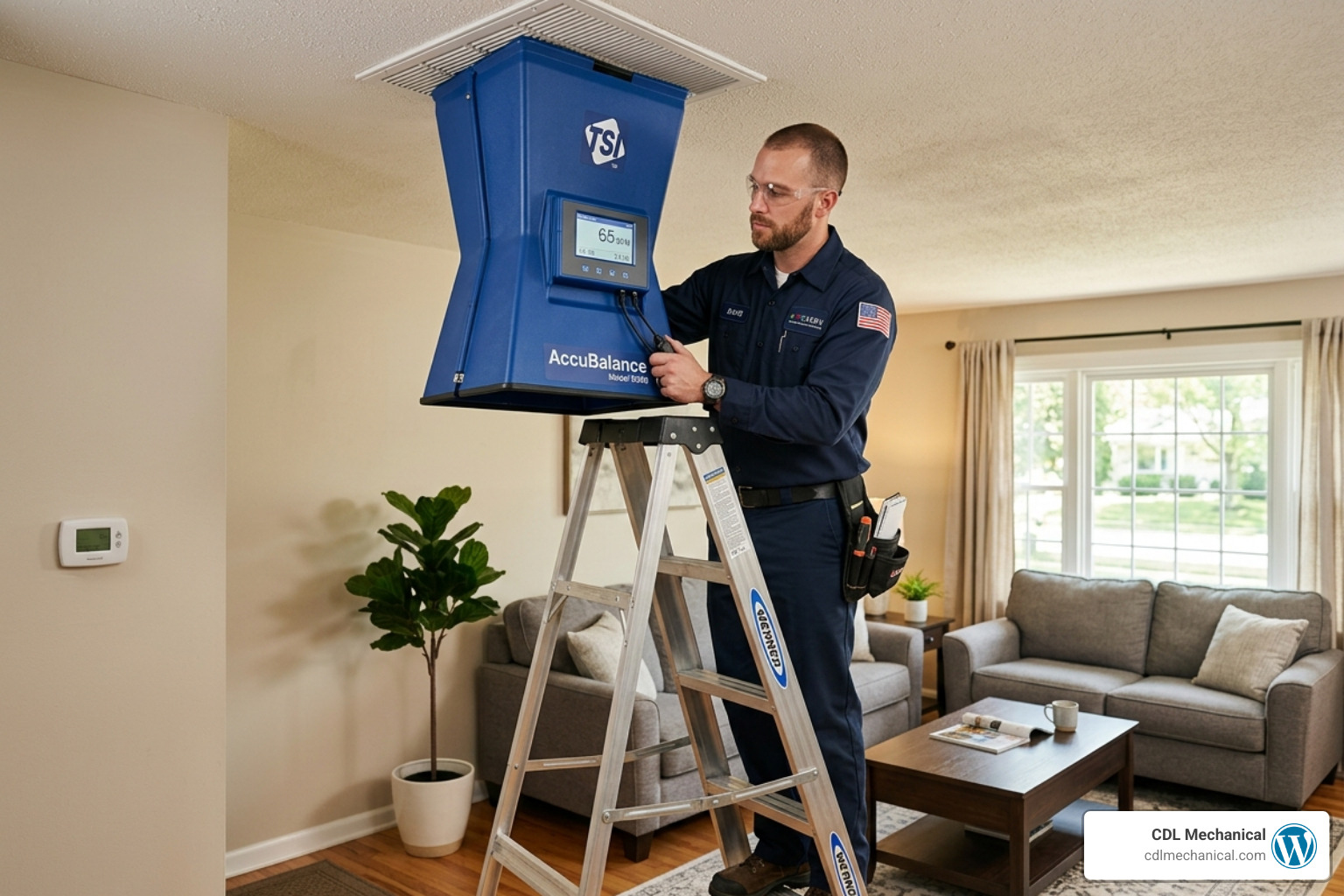
- Flow Hoods (Balometers): These are placed over a vent to measure exactly how many CFM are entering the room.
- Anemometers: These measure the velocity of the air.
- Blower Door Tests: Sometimes, the problem isn’t the ducts—it’s the house. We measure how much air is leaking through the building envelope.
Our process involves “proportional balancing.” We start at the “index circuit” (usually the vent furthest from the fan) and adjust every other damper in the house until the ratios match the design plan. We might also adjust the fan speed on your air handler to ensure it’s pushing enough air to reach the furthest corners of your home. This level of detail is a core part of our maintenance plan.
The Impact of Air Balancing on Equipment Longevity
One of the most significant ways how air balancing improves HVAC efficiency is by extending the life of your expensive equipment. Think of it like an alignment on your car. If your tires are misaligned, your engine has to work harder, your gas mileage drops, and your tires bald prematurely.
An unbalanced HVAC system causes:
- Motor Stress: The blower motor has to fight against high static pressure, leading to premature burnout.
- Short Cycling: Frequent starting and stopping is the number one killer of AC compressors.
- Belt and Bearing Wear: Increased vibration and uneven loads can snap belts and grind down bearings.
| Feature | Balanced System | Unbalanced System |
|---|---|---|
| Energy Waste | Minimal (optimized) | Up to 20-30% |
| Equipment Lifespan | 15-20 Years | 10-12 Years |
| Repair Frequency | Low (routine) | High (frequent breakdowns) |
| Comfort Level | Consistent | Hot/Cold spots |
Investing in 5 benefits of routine AC maintenance—including air balancing—means you won’t be looking for a full system replacement nearly as soon.
Frequently Asked Questions About Airflow Optimization
What is the difference between air balancing and a standard tune-up?
A standard tune-up focuses on cleanliness and mechanical integrity—cleaning coils, checking refrigerant levels, and testing electrical connections. Air balancing is a specialized service that focuses specifically on the distribution of air through the ductwork using diagnostic pressure and volume tools.
Can I perform air balancing myself using the paper test?
The “paper test” (holding a piece of paper to a vent to see if it blows) can tell you if air is moving, but it won’t tell you how much. It’s a good way to spot a completely dead vent, but it lacks the precision needed to actually improve efficiency. Improperly closing too many vents yourself can actually increase static pressure and damage your blower motor.
How often should I have my HVAC system professionally balanced?
You should have your system balanced whenever you make a major change to your home, such as an addition, new windows, or even changing heavy furniture. For most Glendale homes, a full professional balance is recommended every 5 to 7 years, or immediately if you notice persistent comfort issues.
Conclusion
At the end of the day, your home should be your sanctuary from the Arizona sun. Achieving that doesn’t just require a big air conditioner; it requires a smart, balanced one. By understanding how air balancing improves HVAC efficiency, you can take control of your comfort and your wallet.
As a family-owned business, we at CDL Mechanical take pride in treating your home like our own. Whether you are in Peoria, Surprise, or Scottsdale, we are here to ensure your air is moving exactly where it needs to go. Don’t let your energy dollars vanish into thin air.
Schedule your professional Air Balancing service today and feel the difference that a “lean, mean, green HVAC machine” can make for your family.